

First and foremost, our thoughts are with everyone caught up in these events. We know many of you will be feeling unsettled, both about what is happening in the UAE, and what it means for your finances. This market bulletin is to give you a clear, honest picture, and some reassurance grounded in fact.
Financial markets have historically looked through geopolitical shocks unless they materially alter global economic fundamentals. The current escalation in the Middle East has indeed created uncertainty and the potential for heightened market volatility, but it is important to separate short-term reaction from longer-term economic impact.
What’s happened?
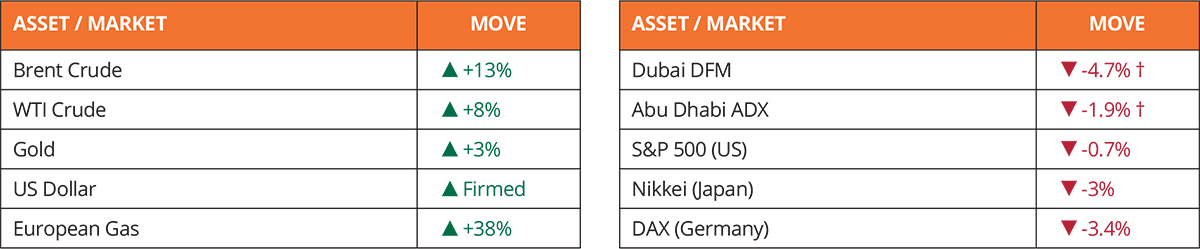
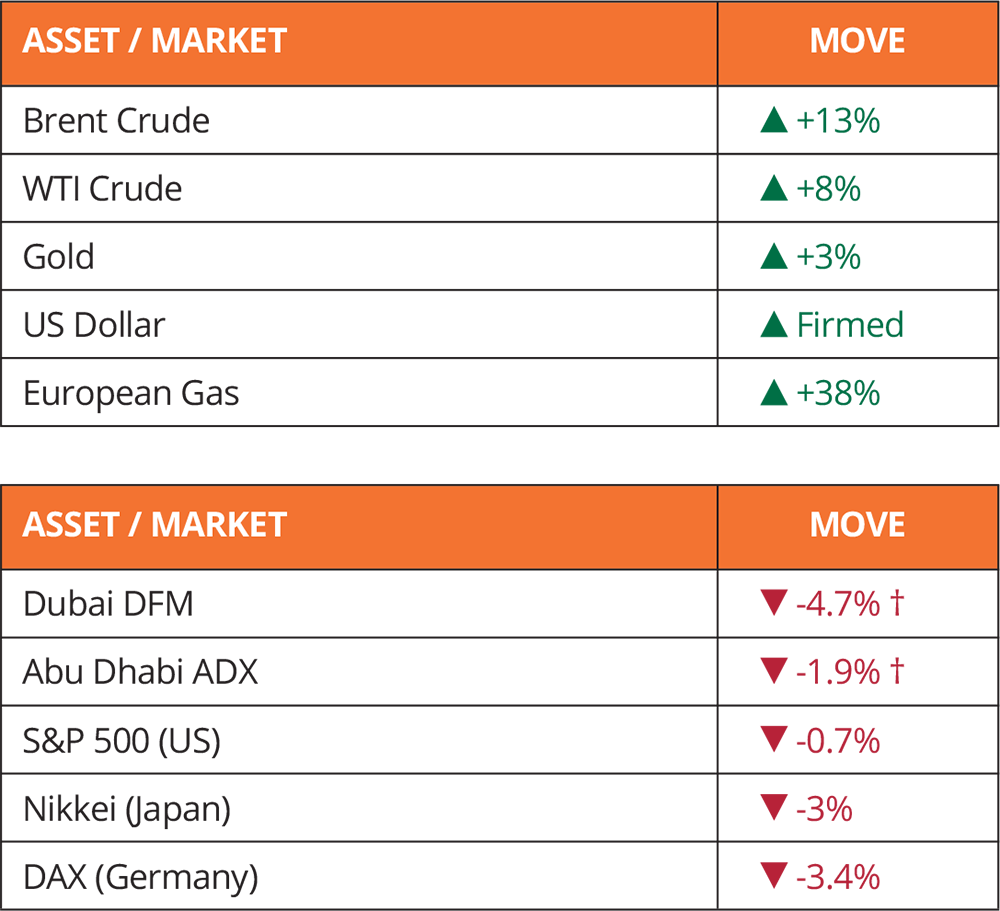
On 28 February 2026, the US and Israel launched air strikes on Iran targeting its leadership and nuclear programme. Iran’s Supreme Leader was killed. Iran retaliated with missiles and drones across the Gulf, including strikes on Dubai Airport, the port of Jebel Ali and parts of Abu Dhabi. The UAE’s stock markets were closed for two days as a precaution, and when they reopened on 4 March, they sold off sharply. Conversely, most commodity values rose. Global equities have encountered short term volatility.
Market moves at a glance
The key risk: the Strait of Hormuz
Around a fifth of the world’s daily oil supply passes through the Strait of Hormuz, and since the conflict began, tanker traffic has dropped to roughly a fifth of normal levels. Saudi Arabia and the UAE can reroute some supply around the Strait, and OPEC+ has agreed to increase production, but these are only partial buffers for as long as the disruption continues. Goldman Sachs estimates that markets are currently pricing in a $14 risk premium per barrel of oil, broadly equivalent to a full four week halt of Strait flows.
If oil prices stay elevated, we will see some upward pressure on inflation globally, and central banks including the US Federal Reserve, are likely to hold off on cutting interest rates.
What could happen next?
• If tensions ease quickly: energy prices fall back, regional markets recover, inflation risk fades.
• If the conflict lasts weeks: oil stays in the $80–$100 range, there’s modest inflation pressure, and central banks remain cautious. This is manageable, but uncomfortable.
• If the conflict drags on or escalates: oil could exceed $100, leading to sharper market volatility, and a real impact on global growth. This is the tail risk – not our base case, but one we are watching closely.
What should I do?
History is clear on this: investors who stay calm and stay invested during geopolitical shocks almost always do better than those who sell in panic. On average, the S&P 500 has gained nearly 3% in the twelve months following a major geopolitical event, even though the headlines look alarming at the time.
As such:
• There is no need to act hastily. Well managed investment portfolios are built to handle periods like this. Market declines due to geopolitical events tend to be shorter than those caused by financial system stress or structural economic imbalances.
• Diversification is key. We have always been strong advocates of holding a well-diversified portfolio. Spreading risk across asset classes and regions, is exactly the buffer that helps at times like these.
• Don’t try to time the market. If we do see an extended period of conflict and markets react as predicted, do not panic. Instead remain calm, and remain invested. Missing the recovery, which often begins before the headlines improve, is the biggest risk to your long-term returns.
• Stay disciplined. No portfolio is immune to short-term volatility, but history tells us that remaining aligned to our medium to longer term goals and risk profile is key.
• Talk to us. If you are worried, please call or email. That is exactly what we are here for.
We will continue keeping you informed of any significant changes in market conditions as they occur. In the meantime, stay safe, and please do not hesitate to contact your Financial Planner should you require any further information.
Kind regards
The Abacus Investment Committee
Please keep in mind that, whilst we aim to update these articles periodically, the content could be subject to future rule changes. Always make sure to speak to a qualified professional to ensure you have the most up to date information and are taking regulated advice around your specific circumstances.